World's First 20-MW Offshore Wind Turbine Powers Up in China
China connects the world's first 20-MW offshore wind turbine to the grid — a 174-metre engineering marvel that can power 44,000 homes.
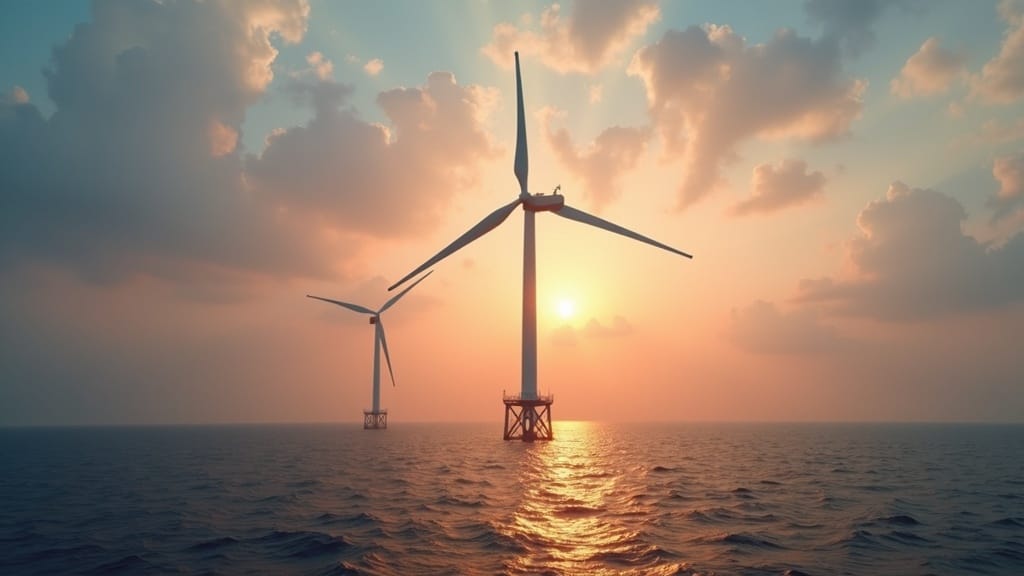
China has connected the world's first 20-megawatt offshore wind turbine to the electrical grid — and the numbers behind it are staggering.
Standing 174 metres tall at its hub (equivalent to a 58-storey building), with a rotor diameter of 300 metres, the turbine's blades sweep an area equal to 10 football fields with each rotation. At full speed, the blade tips travel at over 320 km/h.
Installed by the state-owned China Three Gorges Corporation at the Zhangpu Liuao Phase 2 offshore wind farm off Fujian Province, the turbine began operations on 5 February 2026. It is designed to produce more than 80 million kilowatt-hours of clean electricity annually — enough to power 44,000 homes.
But perhaps the most impressive engineering achievement is invisible to the eye. The development team achieved a head mass of under 40 tonnes per megawatt, making the unit 20% lighter than the industry average for its class. This critical weight reduction meant existing installation vessels with a 2,000-tonne lifting capacity could be used, avoiding the need for expensive new maritime infrastructure.
The turbine's airfoil blades, each approximately 147 metres long, are designed for high-performance flexibility. They achieved a wind energy utilisation coefficient of 0.49, meaning the turbine captures nearly half of the kinetic energy available in the wind — approaching the theoretical maximum.
Key Facts
- 20 MW capacity — the world's largest single offshore wind turbine (Marine Insight)
- 80 million kWh annual output, powering 44,000 homes
- 174m hub height, 300m rotor diameter — blade tips travel at 320+ km/h
- 20% lighter than industry average for its power class
- Built by China Three Gorges Corporation in collaboration with Goldwind
Why This Matters
The previous record holder was a 16-MW turbine at the same wind farm. The jump to 20 MW represents more than incremental improvement — it's a fundamental engineering breakthrough in weight reduction and blade design that could set the template for the next generation of offshore wind farms worldwide.
As nations race to decarbonise their energy systems, larger turbines mean fewer installations needed for the same power output, reducing costs and environmental disruption. If the weight-reduction innovations can be replicated, they could make bigger turbines economically viable in deeper, more challenging offshore locations.
What We Don't Know Yet
This is a single installation, and long-term performance data in extreme weather conditions will take years to accumulate. Scaling production of 20-MW turbines will require significant supply chain development. China's growing dominance in offshore wind technology also raises questions about supply chain dependencies for other nations pursuing ambitious offshore wind targets.
Sources: Marine Insight · ScienceDaily
Published 2026-02-20 · Category: Environment & Climate