A Perovskite Solar Submodule the Size of a Table Hits 23.5 Percent
UNSW and UtmoLight set a certified 23.5 percent efficiency record on a 30-centimetre perovskite solar submodule, narrowing the gap with tiny lab cells.
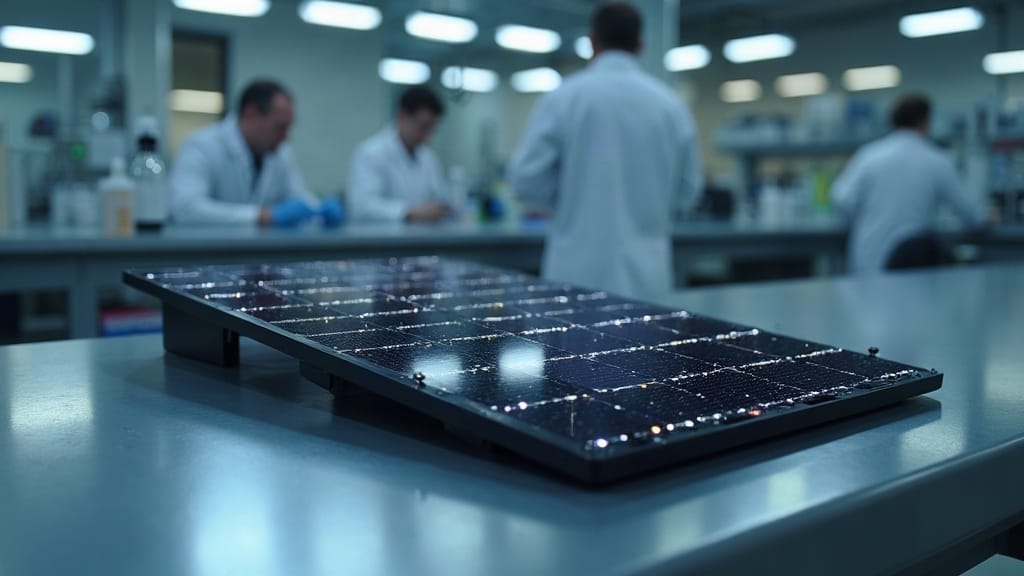
UNSW and UtmoLight set a certified large-area record and dropped a troublesome layer
Engineers at UNSW Sydney, working with UtmoLight, have set a certified efficiency record for a large perovskite solar submodule: 23.5 percent stabilised power conversion, 0.6 points above the previous mark. The module measures 30 by 30 centimetres, with an aperture of 676 square centimetres. Laboratory perovskite cells are often about one square centimetre. The gap between those tiny cells and something a factory could tile has been the objection. This result narrows it. The team, led by Scientia Professor Xiaojing Hao with Dr Zhen Li and Dr Ziyue Feng, also removed the usual nickel-oxide layer. That layer helps prevent short circuits, but it can react with the perovskite and add a manufacturing step. They formed the electrical contact during fabrication instead. A separate Science paper from UC San Diego this week reached about 26 percent on small cells using a temporary liquid during crystal growth, with eight weeks of simulated-sunlight durability. We are not running that as a second story. Small cells with an eight-week test are a method. A certified 30-centimetre submodule is the nearer step to a product, and it still is not a product.
Key Facts
- Certified stabilised efficiency: 23.5 percent
- Module: 30 by 30 cm, aperture 676 cm²
- Previous record beaten by 0.6 percentage points
- Nickel-oxide layer removed
- Lab announcement: around 7 October 2026
- Sources: ESD News, UNSW
Why This Matters
Solar records that only exist on a postage stamp do not change a roof. A certified result on a submodule large enough to manufacture is the number that matters, even if 23.5 percent is below the best tiny cell.
What We Don't Know Yet
- Field lifetime is not a certification of efficiency
- No commercial module price or warranty follows from this result
- The 26 percent small-cell paper is a different experiment