Sierra Leone's Triple Zero Campaign Is Bending a Death Curve, on Preliminary Data
226 days into Sierra Leone's Triple Zero campaign, a preliminary dashboard shows maternal deaths down about a third. The nurse in Congo Town is the story. The audit is not finished.
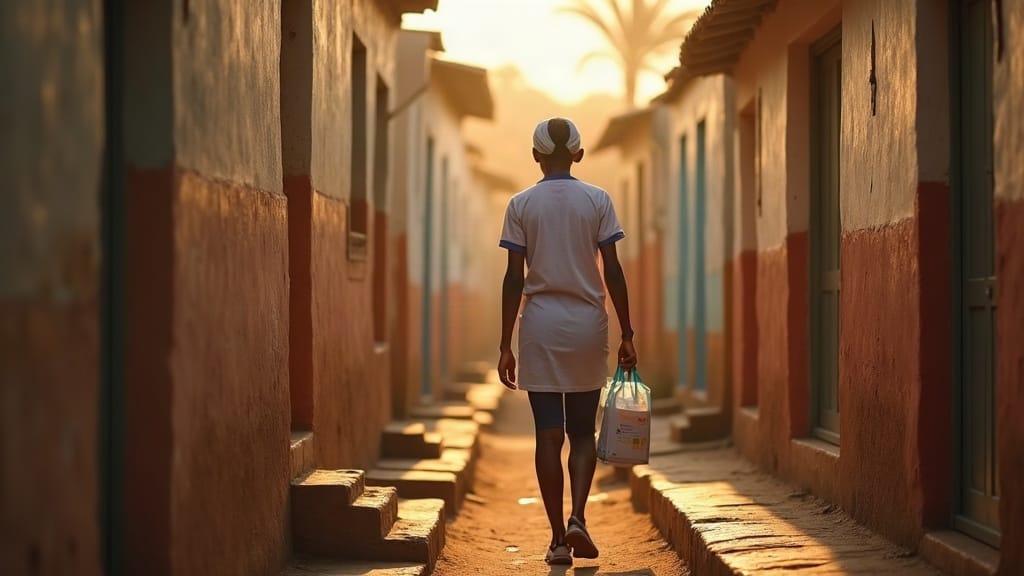
A nurse in Congo Town is finding the children the clinic never saw
On a sunny morning in Freetown, nurse Increase Conteh walked the steep alleys of Congo Town with a vaccine carrier and a notebook of children who had missed their jabs. Congo Town is a settlement of about 24,000 people, built on land reclaimed from the sea. Gavi's Saidu Bah described overflowing sewers, debris, flies, pigs and dogs. Conteh works at Graybush Health Center. Outreach there is now a weekly routine.
Two-year-old Fatmata was on the list because her mother had been away. Therissa Coker, 36, travelled to a village in Port Loko for a funeral and did not get back for eight months. When she returned she started selling cooking ingredients from a table near home. She told Gavi she does not have time to take her daughter to the clinic. Conteh checked the yellow card at the house and gave the missed doses: injections in the arm and thigh, and an oral drop.
That visit sits inside a national push. In March 2026 the Ministry of Health launched 300 Days of Activism for Triple Zero: zero preventable maternal deaths, zero preventable child deaths, and zero children still unvaccinated with a basic diphtheria-tetanus-pertussis dose by 12 months. Dr Desmond Mada Kangbai, who manages the Expanded Programme on Immunization, said the vaccination piece is meant to use routine outreach, not another one-off campaign. WHO and UNICEF estimate about 19,000 zero-dose children in the country, many in slums, border areas and nomadic settlements.
Gavi published the latest dashboard reading on 13 October, day 226 of 300. The ministry's preliminary administrative data, not yet independently validated, showed maternal deaths down 32.2 percent against a 2025 baseline, child deaths down 12.3 percent, and 10,113 zero-dose children reached. Local outlets on 12 October, quoting the ministry as the campaign neared its final phase, gave 31.4 percent, 12.1 percent and 9,930 children, 110.3 percent of the zero-dose target they were using, with the campaign about 73 percent complete. Those are not the same rounded sentence. Both sets are ministry figures reported by journalists. Neither is an external audit.
Health Minister Austin Demby called the movement a demonstration of what is possible when a nation comes together. Deputy Minister Jalikatu Mustapha told a town hall the curve is bending, and that mothers are still dying in childbirth and children are still dying before a first birthday. At that same 12 October town hall at the Miatta Civic Centre, the government said it had deployed 105 ambulances. Dr Francis Moses, director of reproductive and child health, stressed referrals. Mustapha said the referral service would have no day off, no night off and no rain-season off. Gavi also reported 500 bicycles procured for community health workers.
The longer decline is real and incomplete. Gavi, citing UNICEF, says maternal mortality fell from about 1,800 deaths per 100,000 live births in 2000 to about 354 in 2023. Nine children in every 100 still die before age five, down from one in four at the turn of the millennium.
Key Facts
- Gavi report: 13 October 2026, day 226 of a 300-day campaign launched in March 2026
- Dashboard, preliminary, 2025 baseline: maternal deaths −32.2 percent, child deaths −12.3 percent, 10,113 zero-dose children reached
- Local ministry quotes, 12 October: −31.4 percent, −12.1 percent, 9,930 children
- Congo Town: about 24,000 people; nurse Increase Conteh; child Fatmata; mother Therissa Coker
- About 19,000 zero-dose children still estimated nationally (WHO/UNICEF)
- 105 ambulances announced 12 October; 500 bicycles procured for community health workers
- UNICEF via Gavi: maternal mortality about 354 per 100,000 in 2023, from about 1,800 in 2000
- Sources: Gavi, Truth Media, Sierraloaded, AYV
Why This Matters
The useful unit is the alley, not the slogan. A mother who cannot leave a market table does not get vaccinated by a billboard. Outreach, bicycles and ambulances are the unglamorous machinery. The percentage is allowed in the piece only after the people, and only with the validation gap attached.
What We Don't Know Yet
The dashboard has not been independently validated. Gavi's 32.2 percent and the local 31.4 percent should not be blended into a false precision. We do not have a district-level audit, a published definition of "preventable," or confirmation that all 105 ambulances are fuelled and staffed. Zero deaths is the name of the campaign. It is not the result.