Scientists Grow Chickpeas in Simulated Moon Soil, Opening Door to Lunar Farming
Space agriculture breakthrough could enable permanent lunar settlements and Mars missions
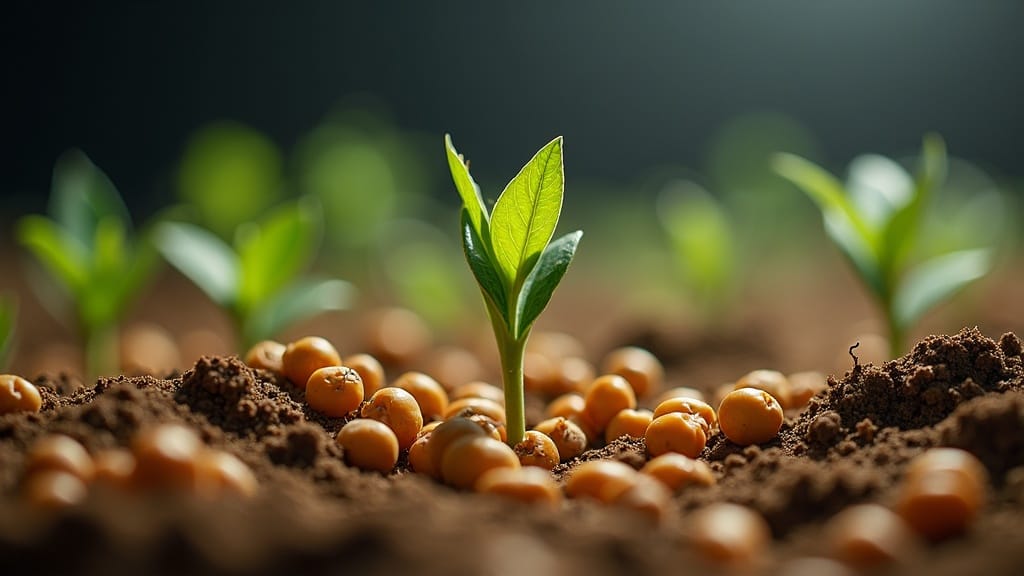
University of Texas researchers have successfully grown and harvested chickpeas in up to 75% simulated lunar regolith, marking the first successful cultivation of this protein-rich crop in moon-like conditions. The breakthrough experiment, published in Scientific Reports journal, offers genuine hope for sustainable food production during future lunar missions and permanent settlements.
The achievement is particularly significant because chickpeas provide essential protein and nutrients that astronauts would need for extended missions beyond Earth. While previous space agriculture research focused primarily on leafy greens, this study demonstrates that nutritionally complete crops can thrive in the harsh conditions astronauts will face on the Moon.
The research team mixed simulated lunar soil with worm compost and mycorrhizae fungi, creating growing conditions that could realistically be replicated on lunar bases using local resources and organic waste from crew members. This practical approach addresses one of the fundamental challenges of long-term space exploration: how to feed people without constant resupply missions from Earth.
As NASA prepares its Artemis missions for lunar base establishment and eventual Mars exploration, sustainable food production becomes a critical capability for human survival beyond Earth's protective environment.
Key Facts
- First successful chickpea cultivation in 75% simulated lunar regolith
- Published in peer-reviewed Scientific Reports journal
- University of Texas at Austin research team
- Chickpeas provide complete protein essential for astronaut nutrition
- Supports NASA's Artemis lunar base development goals
Why This Matters
Previous space agriculture research has primarily focused on fast-growing leafy vegetables and herbs, with NASA's Vegetable Production System (Veggie) successfully growing lettuce, radishes, and other greens on the International Space Station. However, these provide limited nutritional value for long-term human health in space.
Chickpeas represent a significant nutritional upgrade, offering complete proteins, essential amino acids, fiber, and calories necessary for sustaining human health during extended missions. The legume also naturally fixes nitrogen in soil, potentially improving growing conditions for other crops in closed-loop lunar agricultural systems.
The research builds on growing understanding of how mycorrhizae fungi can help plants adapt to challenging growing conditions, potentially making them crucial partners in space agriculture systems.
What We Don't Know Yet
The experiments were conducted in Earth gravity rather than the Moon's one-sixth gravity environment. Long-term effects of lunar radiation on plant growth remain unknown and couldn't be simulated in Earth-based labs. The study used simulated rather than actual lunar soil, which may have different chemical and physical properties. Scaling from laboratory experiments to functional lunar agriculture would require significant additional research and development.