The Salmon Swim
Eighteen volunteers in Somerset lived a day as a salmon, a deer, or an earthworm, then wrote a 30-year plan for the River Tone.
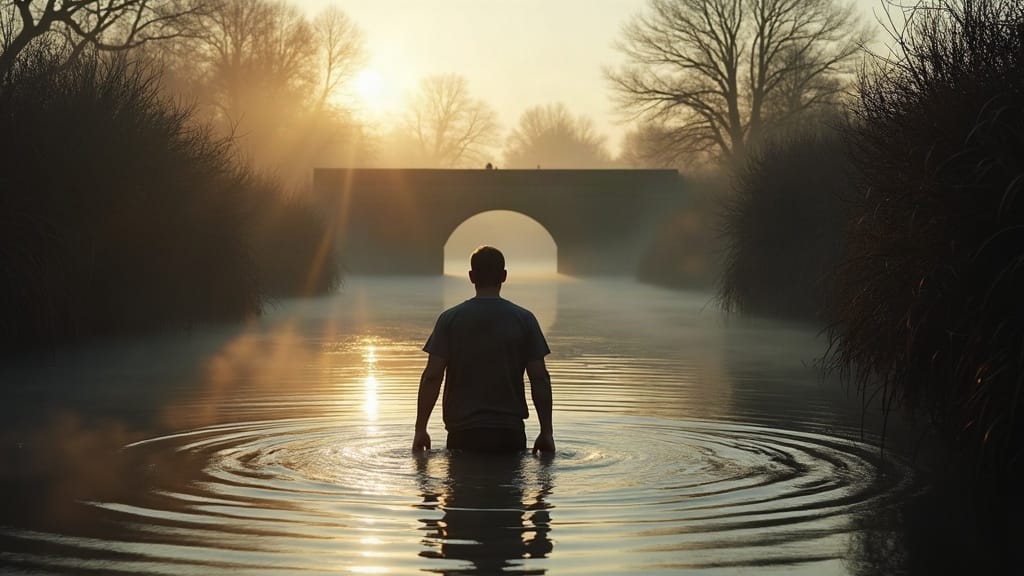
Jake Lawy swam the Tone as a salmon. He came out wanting the streetlights off.
Jake Lawy got into the River Tone and swam it the way an Atlantic salmon would have to. The water was polluted. The oxygen was poor. He knew both of those things before he got in. Knowing them from the bank and knowing them from inside the river turned out to be different.
He was one of 18 volunteers on a study called Risks Beyond Human Eyes, run by the University of the West of England with the Accelerator for Systemic Risk Assessment. Each volunteer was trained in the physiology and the sensory world of one animal — red deer, kestrel, otter, earthworm, or salmon — and then sent out to spend time as that animal on their stretch of river. Lawy took the salmon. He came back with two asks that a parish council could actually action: turn off the streetlights closest to the water, and take out the old weirs.
James Tovey, ASRA's director, framed it without the mysticism. The animals are not suffering because they are wild. They are suffering because of particular things people have done and are still doing. The study's output is a 30-year route for the Tone bioregion, plus an interactive map ASRA calls the NCA Demonstrator. The method is built to be copied. ASRA describes it as a model other bioregions can adapt.
The cold open is Lawy in the water. The number 18 comes second. The 30-year plan comes third, and it comes with the honest limit: we have not seen a budget line, and no streetlight has been confirmed switched off.
Key Facts
- 18 volunteers, five species: Atlantic salmon, red deer, kestrel, otter, earthworm
- River Tone, Somerset
- Led by the University of the West of England and ASRA; James Tovey is ASRA's director
- Lawy's two concrete asks: riverside streetlights off, old weirs out
- Output: a 30-year plan for the Tone bioregion, and the NCA Demonstrator, a 3D map of the evidence
- Reported by Robin Eveleigh, Positive News, 19 October 2026
Why This Matters
River plans are usually written from the bank, by people who have never been cold in the water they are regulating. This one started with someone who had. The asks that came out of it are small enough to be done this year, which is the version of a 30-year plan that doesn't evaporate. And the method travels. A bioregion that wants to try it does not need a new university.
What We Don't Know Yet
Whether a single streetlight has been switched off, or a single weir booked for removal. The plan is a plan. There is no budget in the piece we read. "Once you see it, you can't unsee it" is Lawy's line, and it is a feeling, not an outcome. Do not say the Tone has been saved.