The Number That Moved, and the One That Did Not
In a phase 3 trial, mitapivat raised haemoglobin in 41 percent of people with sickle cell disease, versus 3 percent on placebo. The pain-crisis rate did not fall enough to be significant.
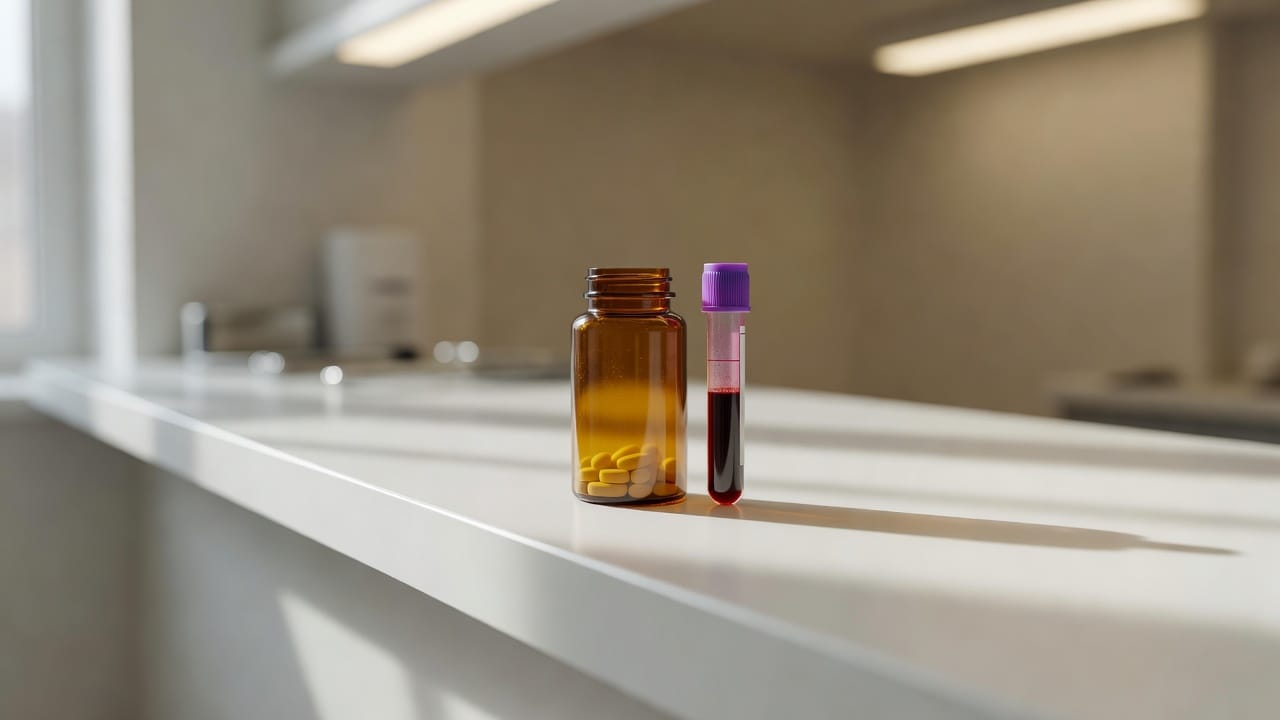
Mitapivat raised haemoglobin in sickle cell disease. Pain crises did not fall enough to count.
RISE UP is a phase 3 trial of mitapivat, a pill that activates pyruvate kinase, in people older than 16 with sickle cell disease and recurrent pain crises. Two hundred and seven patients at 69 sites in 15 countries were randomised two to one: 138 to mitapivat 100 milligrams twice a day, 69 to placebo.
One primary endpoint hit. From week 24 to week 52, 56 of 138 people on the drug raised their average haemoglobin by at least 1.0 gram per decilitre. That is 41 percent. Two of 69 on placebo did. That is 3 percent. The adjusted difference was 38 percentage points, confidence interval 29 to 47, p less than 0.0001.
The other primary endpoint did not. The annualised rate of sickle cell pain crises was 2.6 on mitapivat and 3.1 on placebo. The p-value was 0.1213. A higher haemoglobin is not, in this trial, a proven cut in the crises that send people to hospital.
Serious adverse events were reported in 20 percent of people on mitapivat and 29 percent on placebo. One serious event on the drug was judged related to treatment, and none on placebo. The Lancet notes that in the people whose haemoglobin did rise, the mean change was comparable to a monthly transfusion of about two units.
Biree Andemariam of the University of Connecticut is the corresponding author. The paper was published on 24 October 2026. The trial is NCT05031780. An extension study is still open. Agios has said it intends to take the package to the FDA. An intention is not a decision.
This is a card, not a second medicine film. The lung-cancer trial is the segment, because that one moved survival. This one moved a blood count and missed the pain.
Key Facts
- 207 patients, 69 sites, 15 countries, published 24 October 2026 in The Lancet
- Haemoglobin response: 41 percent versus 3 percent, p<0.0001
- Annualised pain crises: 2.6 versus 3.1, p=0.1213
- Serious adverse events: 20 percent versus 29 percent
- Oral mitapivat, 100 milligrams twice daily
- NCT05031780
Why This Matters
Transfusions work, and they are not a life. A pill that lifts haemoglobin in two people in five, against almost nobody on placebo, is a mechanism that landed. The crisis count is the outcome patients name first. It did not clear the bar the trial set.
What We Don't Know Yet
Whether longer follow-up moves the crisis rate. Whether regulators accept a hit on one primary endpoint and a miss on the other. Nothing here is a cure, and nothing here should be said as fewer nights in hospital.