The World's Mangroves Gained 477 Square Kilometres. Indonesia Lost 2,043.
Satellite maps show global mangrove cover up 477 square kilometres since 1985. India gained. Indonesia lost 2,043. Many new stands sit on fresh sediment, not old forest.
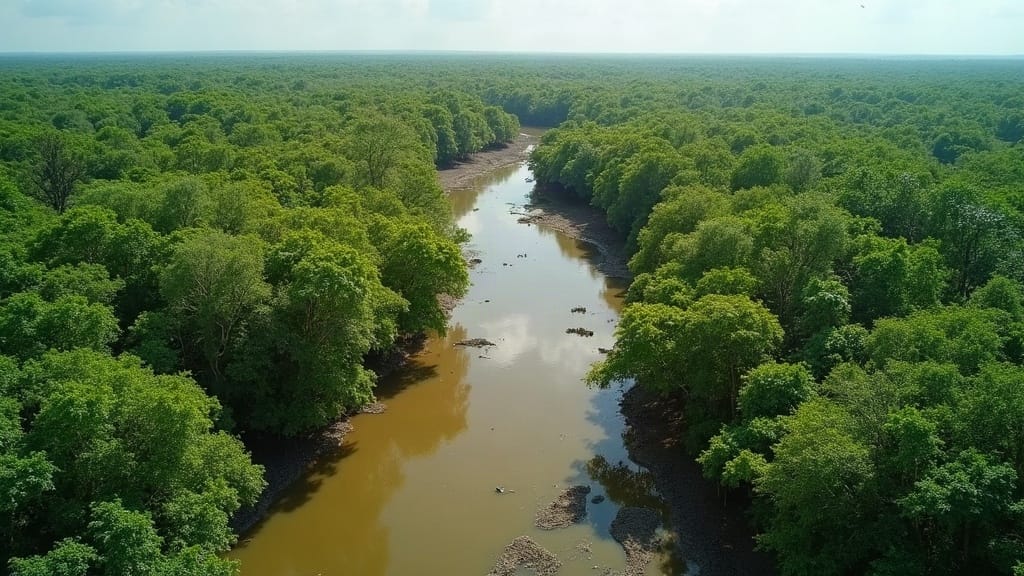
A fish-bone canal in Tamil Nadu explains more than a planting day
From the late 1980s, crews in Tamil Nadu and Andhra Pradesh dug narrow channels into mudflats in the shape of a fish skeleton. Tide came in. Tide went out. The soil stopped being a salt pan, and mangroves could take. Ramasubramanian R., a restoration scientist at the M.S. Swaminathan Research Foundation, told Mongabay that the turnaround in India was that engineering, plus a government decision to stop felling and to pay people to plant instead of cutting firewood. Women, he said, manage both the fuel and the restoration, which is why putting them in the work reduces pressure on the trees.
Mongabay published the global ledger on 14 October 2026. Global Mangrove Watch, mapped at 10-metre resolution across 108 countries, shows cover up by 477 square kilometres between 1985 and 2025. That is 0.3 percent. India added 1,180 square kilometres. Pakistan, Australia, Senegal and the Philippines also gained. Indonesia, with about a fifth of the world's mangroves, lost 2,043. Myanmar lost 1,458. Malaysia 390. Nigeria 312. Cuba 272.
Lammert Hilarides, who leads Global Mangrove Watch at Wetlands International, said the point of the map is that you cannot halt a loss you cannot see. He also said Indonesia's net decline has slowed since 2010, and that since 2015 Indonesia has been among the three countries adding the most cover. The Caribbean and Central and North America did the opposite: gains from 1985 to 1995, and a decline in the last five years whose drivers are still unknown.
The State of the World's Mangroves 2026, published on 1 October, says the tide has turned and also says the new hectares are not the old forest. About 65 percent of gains are in places mangroves had not grown before, often on sediment washed off deforested hills inland. Mass planting that ignores tide and community ownership fails. Hilarides said restoring a forest is not a seedling quota.
In the Niger Delta, Nnimmo Bassey of the Health of Mother Earth Foundation told Mongabay that about 260,000 barrels of crude have spilled into the delta annually for nearly seven decades. A restored mangrove there would be a fishery and a livelihood. It is not what the global net number describes.
Key Facts
- Mongabay: 14 October 2026. State of the World's Mangroves: 1 October 2026
- Net gain 1985–2025: 477 square kilometres, about 0.3 percent, 108 countries
- India: plus 1,180 square kilometres. Indonesia: minus 2,043
- Fish-bone canals in Tamil Nadu and Andhra Pradesh from the late 1980s
- About 65 percent of gains are on ground that was not previously mangrove
- Sources: Mongabay, Wetlands International, Global Mangrove Watch
Why This Matters
The useful unit is the canal, not the press photo of children holding seedlings. Tide either reaches the mud or it does not. A global plus sign that hides an Indonesian minus sign is how restoration stories go soft.
What We Don't Know Yet
The Caribbean decline of the last five years does not yet have a published driver. We do not have a 2026 audit of how many Indian fish-bone sites are still flushed. New sediment is not a restored old forest, and the carbon and fisheries of a young stand are not the carbon and fisheries of a century-old one. Nigeria's oil figure is an advocate's estimate given to a reporter, not a regulator's ledger.