From Coal Slag to Green Flag: How a French Mining Town Became a Blueprint for Just Transition
A French mining town spent 20 years transforming into a sustainability model. Loos-en-Gohelle shows what a just transition looks like in practice.
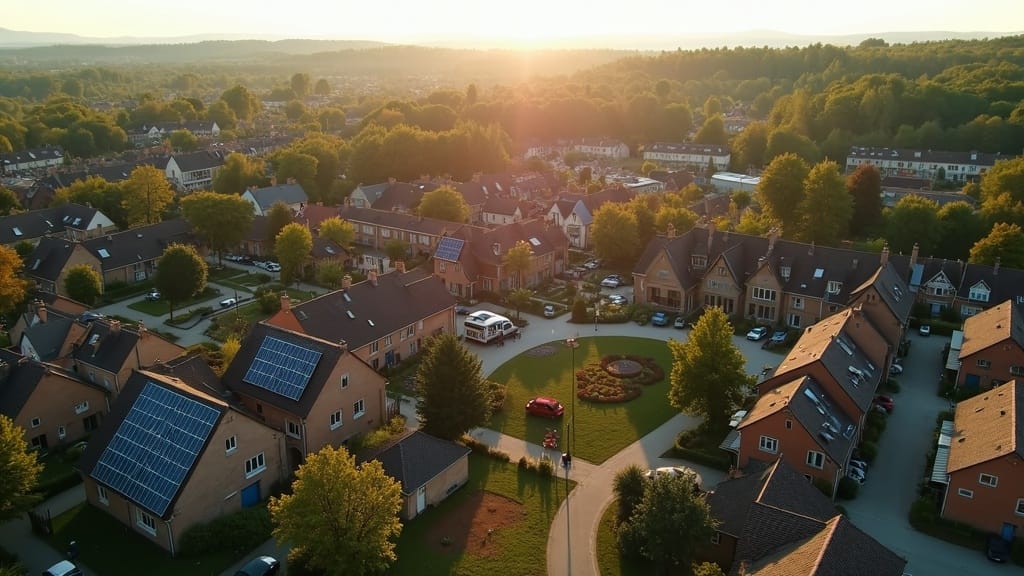
Loos-en-Gohelle, a former coal mining town in France's Pas-de-Calais region, has spent two decades transforming itself from post-industrial decline into a nationally recognised model for sustainable transition. And the rest of Europe is finally paying attention.
The town of 7,000 people invested in renewable energy, circular economy initiatives, and — critically — community-led governance that gave residents ownership of the transformation. This wasn't a top-down technocratic makeover. It was a community deciding, together, what comes after coal.
The results are tangible. Renovated social housing with 50% reduced energy consumption. Solar installations on former slag heaps — literally turning industrial waste into clean energy infrastructure. Thriving local food systems. A civic engagement model that other French communes now study and attempt to replicate.
The former mining headframes are UNESCO World Heritage-listed, anchoring a new identity that honours the town's industrial past while pointing toward a different future. The transformation began in the early 2000s under Mayor Jean-François Caron, who understood that transition isn't just about economics — it's about identity.
What makes Loos-en-Gohelle stand out isn't any single initiative. It's the system. The town's approach integrates energy, food, housing, governance, and culture into a coherent transition strategy. In a Europe where dozens of coal regions face similar decline, it offers a replicable playbook.
Key Facts
- Population: ~7,000, in Pas-de-Calais, northern France
- Transition began in early 2000s under Mayor Jean-François Caron
- 50% reduction in energy consumption in renovated social housing (Reasons to Be Cheerful)
- UNESCO World Heritage status for the Nord-Pas-de-Calais mining basin (inscribed 2012)
- Designated France's national "Ville Pilote du Développement Durable" (pilot city for sustainable development)
Why This Matters
Europe's coal regions face an existential challenge. As climate policy accelerates the phase-out of fossil fuels, communities built around coal risk economic collapse, depopulation, and political radicalisation. The pattern is visible from Poland's Silesia to Germany's Lausitz to Britain's former coalfields.
The EU's Just Transition Mechanism has allocated €55 billion to support affected regions. But money alone doesn't create transformation — governance models, community buy-in, and integrated planning do.
Loos-en-Gohelle demonstrates what "just transition" looks like in practice, not theory. It shows that a small, poor, post-industrial town can reinvent itself without erasing its history. The former miners' descendants aren't ashamed of where they come from — they've built something new on that foundation.
What We Don't Know Yet
The primary English-language source for this story is a single piece of strong journalism from Reasons to Be Cheerful. Independent verification of the key claims would strengthen confidence in the narrative.
Loos-en-Gohelle is a town of 7,000. Whether this model scales to larger industrial cities — with more complex economies, more entrenched interests, and more diverse populations — is an open question.
Two decades of sustained political leadership under the same mayor is a key factor in the town's success. Replicability in contexts where leadership changes frequently is unclear.
France's centralised governance structure and access to EU funding create conditions that differ significantly from other coal regions. What works in Pas-de-Calais may not translate directly to Appalachia or Silesia.
Many of the success metrics are largely self-reported. Independent evaluation of outcomes — particularly the economic sustainability of the model — would strengthen the case for replication.
Sources: Reasons to Be Cheerful · UNESCO World Heritage · EU Just Transition Mechanism
Published 16 February 2026 · Category: Environment & Climate / Community & Society