The Leap Second Lost the Vote
Sixty-nine countries voted on 15 October to end leap seconds from 20 May 2027. UTC may drift up to an hour from astronomical time. A leap hour is centuries away.
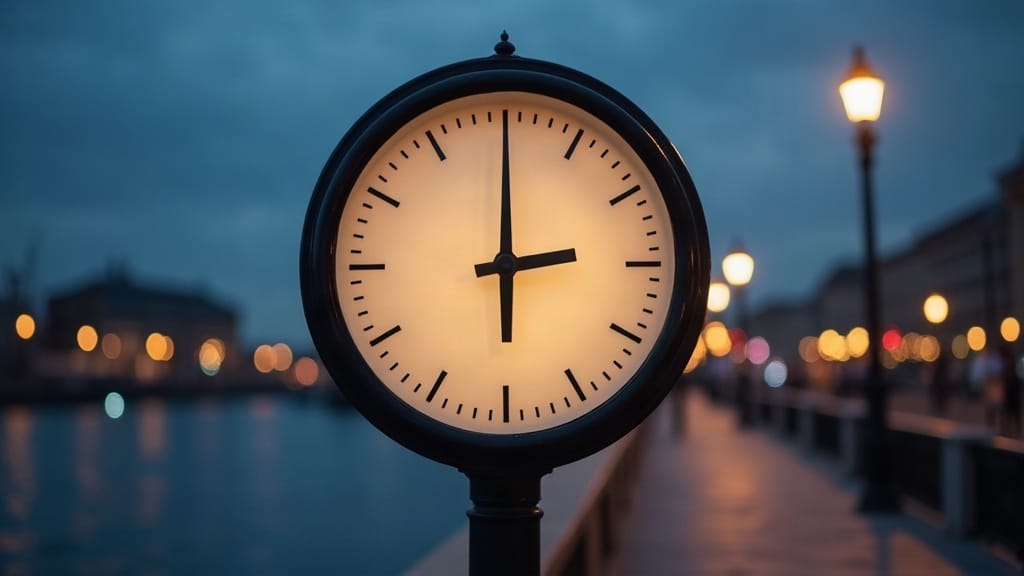
Emily Akkermans keeps the public clocks at the Royal Observatory in Greenwich. She described the decision as daylight saving that does not end. Not next spring. Permanently, and slowly.
On 15 October 2026 the 28th General Conference on Weights and Measures, meeting in Versailles, adopted Resolution 5. Representatives of 69 countries voted. Noël Dimarcq, president of the Consultative Committee for Time and Frequency, said continuous Coordinated Universal Time takes effect on 20 May 2027. That date is World Metrology Day, the anniversary of the 1875 Metre Convention. The new rule lets UTC drift up to one hour from astronomical time, UT1, before anyone inserts a correction. The correction, if it ever comes, is a leap hour.
The leap second has been the patch since 1972. Earth's spin is not the caesium-133 vibration that defines the second, so the timekeepers have been adding a second when the two drifted toward 0.9 seconds apart. New Scientist counted 27 of those seconds. Wired, citing the International Bureau of Weights and Measures, counted 32. Both numbers are in print this week. They do not agree, and neither outlet shows the working.
The reason for the hurry is a minus sign. Earth's rotation has sped up slightly. That raised the chance of a negative leap second, a clock jumping backwards, which has never been done. Patrizia Tavella of the bureau said industry tests showed several failures on a negative leap. Setnam Shemar at the National Physical Laboratory in Teddington said earlier positive leap seconds have already crashed websites and snarled airline booking systems.
Christian Bizouard, who directs the Earth Orientation Center that actually announces the seconds, told the Guardian this is a decision pushed into the next millennium. A leap hour needs 3,600 seconds of drift. What changes in May 2027 is the absence of a jump, not the time on a wristwatch on Monday morning.
Key Facts
- Vote: 15 October 2026, 28th General Conference on Weights and Measures, Versailles
- Resolution 5, continuity of Coordinated Universal Time
- 69 countries
- Continuous UTC from 20 May 2027
- Tolerance versus astronomical time: one hour, then a leap hour
- Leap seconds added since 1972: 27 in one count, 32 in another
- A negative leap second has never been issued
Why This Matters
The leap second is a rare case where a philosophical argument has a failure mode you can name: a website, a booking system, a grid that assumes time does not go backwards. Ending it is a fix. Pretending the sky and the clock will still match is the part that would be a lie.
What We Don't Know Yet
The two published counts of leap seconds since 1972 do not match. How far UTC and UT1 already sit apart this week is not in the news copy. A leap hour "several centuries" out is Dimarcq's phrase, not a calculated date.
Sources: BIPM statement · New Scientist