India Adds Record 52 GW of Power Capacity in Ten Months, 75% from Renewables
India adds a record 52 GW of power capacity in 10 months, with 75% from renewables — led by a massive 35 GW solar surge.
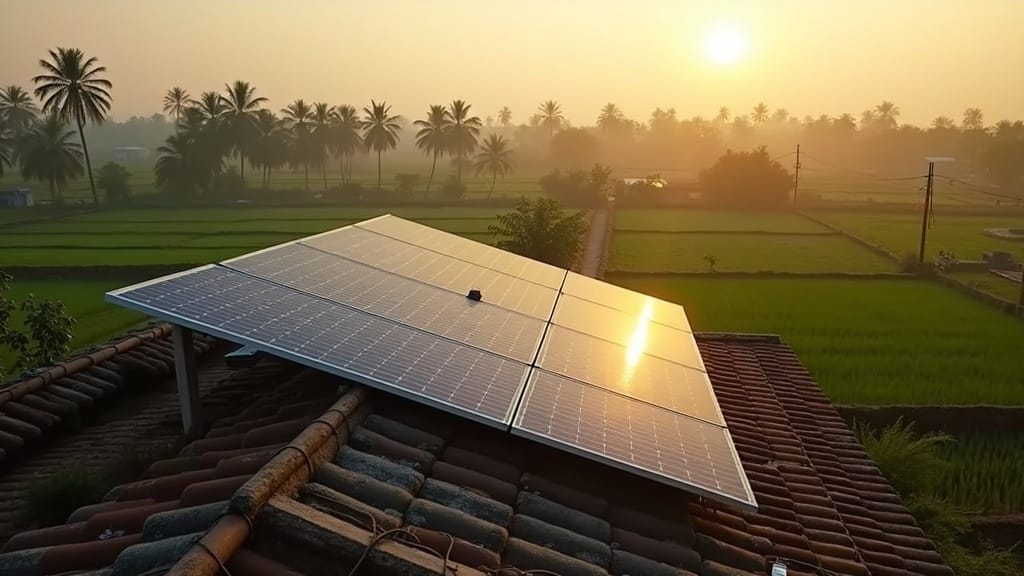
India has added a record 52,537 MW of new power generation capacity in the first ten months of the current fiscal year — and three-quarters of it is renewable.
Solar energy alone accounted for nearly 35,000 MW, with wind contributing a further 4,600 MW. The country's total installed capacity has now reached 520.6 GW, according to the Ministry of New and Renewable Energy.
The numbers represent an extraordinary acceleration. India's renewable buildout has moved from policy ambition to physical reality at a pace that has surprised even optimistic forecasters. At this rate, the country is on track to exceed its 500 GW non-fossil fuel capacity target well ahead of the 2030 deadline set under the Paris Agreement.
For 1.4 billion people, many of whom still experience unreliable power supply, the expansion carries immediate practical significance. New solar capacity is being deployed not just in utility-scale installations but increasingly on rooftops, in industrial parks, and through distributed generation models that can reach rural communities faster than grid extension.
The economics have become self-reinforcing. Solar tariffs have fallen below coal generation costs in most Indian states, making renewable energy the cheapest option for new power in the country. Private-sector investment has surged accordingly, with companies like Tata Power Solar and Adani Green Energy scaling operations rapidly.
India's manufacturing ambitions add another dimension. Production-linked incentives for domestic solar panel manufacturing are beginning to reduce dependence on Chinese imports, though the country still relies heavily on imported cells and modules. The International Solar Alliance, headquartered in India, has positioned the country as a leader among developing nations in clean energy deployment.
Paired with China's clean energy milestone — also reported this week — India's record additions confirm that the global energy transition is now being driven primarily by Asian deployment at scales that dwarf installations in Europe and North America. Together, China and India account for roughly 35% of global CO₂ emissions; their simultaneous pivot toward renewables is among the most consequential energy shifts in history.
Key Facts
- 52,537 MW new capacity added in first 10 months of FY26
- 39,657 MW (75%) from renewable sources
- Solar: 34,955 MW; Wind: 4,613 MW
- Total installed capacity: 520.6 GW
- Solar tariffs are now below coal generation costs in most Indian states
Why This Matters
India's energy choices affect a fifth of humanity. The fact that three-quarters of new capacity is now renewable signals a structural shift that goes beyond policy announcements — this is money being spent, infrastructure being built, and electrons being generated at scale.
The combination of India's renewable surge and China's capacity milestone in the same week illustrates a broader truth: the global energy transition is no longer primarily a European or American project. It is being built, at unprecedented speed and scale, in Asia.
What We Don't Know Yet
Coal still generates roughly 70% of India's electricity. Capacity additions do not equal generation share, and the gap between installed renewable capacity and actual clean power output remains significant.
Grid integration and transmission infrastructure remain bottlenecks. India's grid was designed around centralised coal plants, not distributed solar generation, and upgrading it is a multi-decade challenge.
Renewable capacity factors in India — especially for wind — are lower than in some other markets, meaning that a megawatt of installed capacity produces less electricity than the same capacity in, say, the North Sea.
Land acquisition for large solar farms has generated local opposition in several states, raising questions about environmental and social trade-offs. Energy storage deployment lags behind renewable installation, creating reliability concerns during evening peak demand.
Sources: The Hindu Business Line · Business Standard
Published 21 February 2026 · Category: Environment & Climate