The Door
University of Hull tests found synthetic rubber tape cut door leakage by 99 percent and duct tape by 97 to 98 percent. Sandbags managed 70 percent. The tests stopped at 600 millimetres.
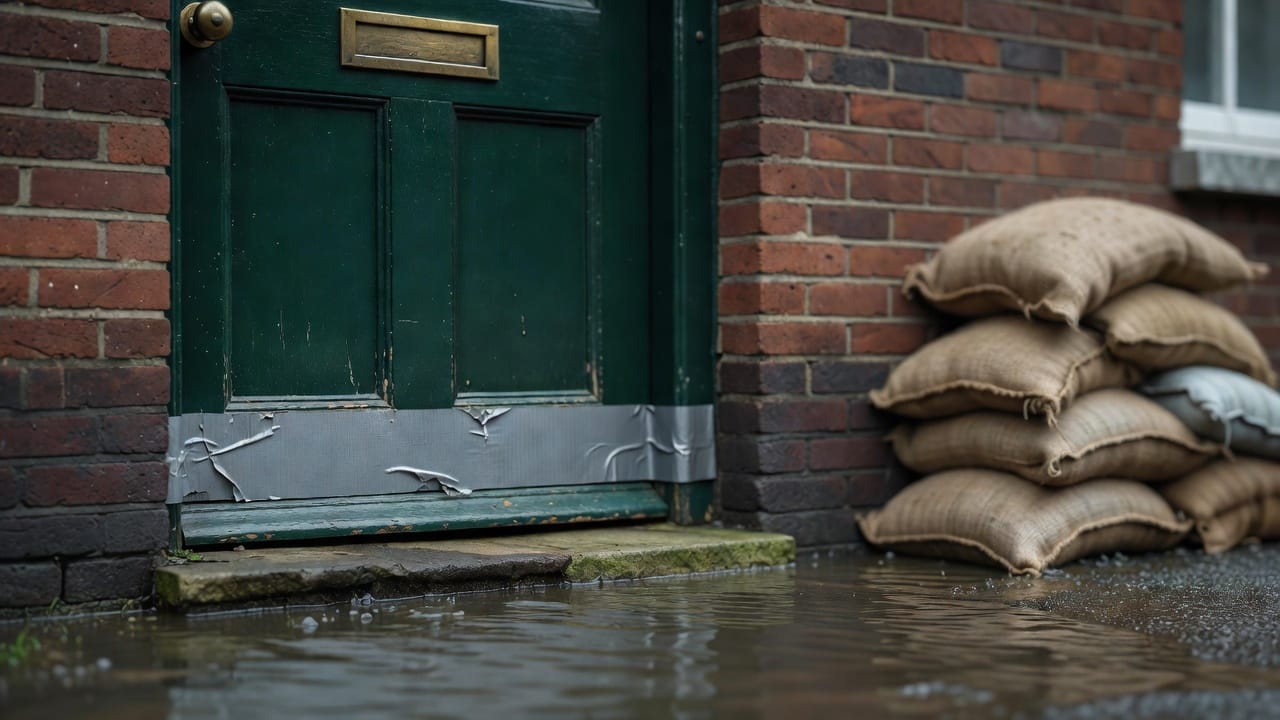
In a Hull lab, tape kept out more floodwater than fifty-four sandbags.
The University of Hull has a lab built to flood doorways on purpose. Flood Re commissioned it to test the things people actually have when the water is already in the street.
Researchers raised water to 600 millimetres against six common types of front door. That depth is the low-level flooding Hull lived through in 2007, when more than 8,600 homes and 1,300 businesses were damaged. It is not a river overtopping a defence.
Against an unprotected door, flexible synthetic rubber tape — flood-putty tape, in the insurance write-up — cut leakage by 99 percent. Duct tape cut it by 97 to 98 percent. The weakest tape in the set still cut leakage by 80 percent. Sandbags, at their best in the same tests, cut it by 70 percent.
The sandbag comparison was not a token stack. A lab account of the method said they used 54 sandbags, with plastic sheeting between the bags and the door. Tape was lighter, already in a drawer or available for the price of a roll, and it did not rot in storage.
Where the tape went mattered. On the outside of the door it worked better than on the inside. Outward-opening doors did better than doors that open in. A barrier product in the same programme was mixed: some installs held, some failed, and the difference was the person fitting it.
Jonathan Kassian, Flood Re's head of flood resilience, said the tests turn the sandbag assumption on its head. Emma Hardy, the flood minister, said simple products could matter for communities. A minister's sentence is not a result. The result is the leakage rate.
The work was published by the university on 15 October 2026, with a report on Zenodo, and reported by the BBC the same day. It was still moving through the trade press on 19 October. The picture is a door with a strip of tape, not a scheme launch.
It is a laboratory. The water was clean enough to measure. Debris, a warped frame, and a depth past 600 millimetres were not the test. Tape on a door is not a reason to ignore an evacuation order.
Key Facts
- University of Hull property-flood lab, commissioned by Flood Re
- Published 15 October 2026; BBC the same day
- Synthetic rubber tape: 99 percent less leakage than an unprotected door
- Duct tape: 97 to 98 percent
- Weakest tape: 80 percent
- Sandbags: 70 percent at best; 54 bags in the stack described by the lab
- Test depth: up to 600 millimetres
- Tape on the outside beat tape on the inside
Why This Matters
Sandbags are the picture people are handed, and they are heavy, late, and in this lab worse than a kitchen-drawer fix. The finding is narrow on purpose. Narrow is still useful if the flood you actually get is two feet at the door.
What We Don't Know Yet
How the tapes hold on a door that no longer sits square, in dirty water, at night. What happens above 600 millimetres. Whether people apply the tape to the outside, which is the side that worked, or to the inside, which did not. A lab doorway is not a street.