Unlocking the Deep: France’s First Floating Wind Farm Begins Powering the Grid
The Gulf of Lion has become the site of a pivotal shift in renewable energy as Ocean Winds commences electricity production at its floating wind farm.
Unlocking the Deep: France’s First Floating Wind Farm Begins Powering the Grid
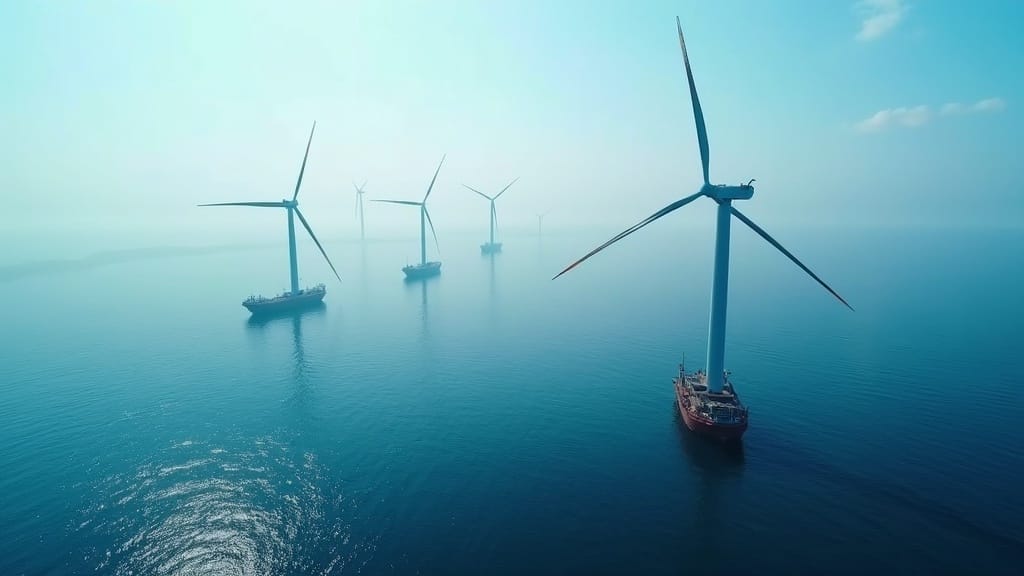
The Gulf of Lion has become the site of a pivotal shift in renewable energy. Ocean Winds has officially commenced electricity production at its 30 MW floating offshore wind farm, EFGL. Unlike traditional offshore wind, which requires turbines to be fixed to the seabed—limiting them to shallow coastal waters—this project utilizes floating platforms.
This milestone transforms the technical potential of wind energy. By decoupling the turbine from the seafloor, we can now harvest the stronger, more consistent winds found in the deep ocean, where the majority of the world's offshore wind potential resides. The EFGL project serves as a critical proof-of-concept, demonstrating that the infrastructure can withstand the rigors of the open sea while delivering steady power to the grid.
For decades, the ambition of offshore wind was constrained by the simple physics of depth. Once the water became too deep for steel monopiles or jackets—typically beyond 60 meters—the wind was effectively unreachable. Floating wind technology, essentially giant buoys anchored by heavy-duty cables, removes this barrier entirely. This opens up vast swathes of the ocean for energy production, particularly in regions with narrow continental shelves where the seabed drops off quickly.
France has been aggressively pursuing this transition to meet its carbon-neutrality goals, and EFGL is the first tangible result of that strategic pivot. The project proves that the logistical challenge of deploying and maintaining turbines in deep water is solvable, provided the engineering is robust enough to handle the Mediterranean's unique conditions.
While the current scale is a pilot at 30 MW, the implications are global. This success paves the way for massive industrial scaling. If floating wind can be commercialized at scale, it could potentially add terawatts of clean capacity to the global energy mix, turning the deep ocean into the new frontier of the green revolution.
Key Facts
- Capacity: The project provides 30 MW of floating capacity, serving as a primary proof-of-concept for the region [Ocean Winds].
- Location: Situated in the Gulf of Lion, France, leveraging deep-water wind currents [Ocean Winds].
- Technology: Utilizes advanced floating foundations that decouple the turbine from the seabed [Ocean Winds].
Why This Matters
This isn't just about adding another few megawatts to the grid; it's about expanding the map of where energy can be produced. By moving into deep waters, we reduce the visual impact on coastlines and access wind speeds that are significantly higher and more stable than those found near the shore. This increases the capacity factor of each turbine, making wind energy more reliable and cost-competitive.
Furthermore, it positions France and its partners as leaders in a technology that will be essential for other coastal nations with deep waters, such as Japan, the US West Coast, and Norway. The EFGL project is the first domino to fall in what could be a global shift toward deep-sea energy harvesting.
What We Don't Know Yet
At 30 MW, this is still a demonstration project. The primary remaining hurdles are the cost of floating foundations compared to fixed ones, which are currently more expensive to manufacture and deploy. Additionally, the long-term maintenance of power cables in deep-sea environments—where pressure and currents are more intense—remains an open question. We must avoid framing this as a "solved problem" and instead present it as a "proven possibility" that now requires economic scaling.
Sources: Ocean Winds
Published 2026-05-06 · Category: Environment & Climate