A bleached coral fragment coloured up where it touched its clone
Bleached coral recovered in seven weeks after touching a healthy clone of itself. The fragments that did not touch died. A Stanford lab result, not a reef treatment.
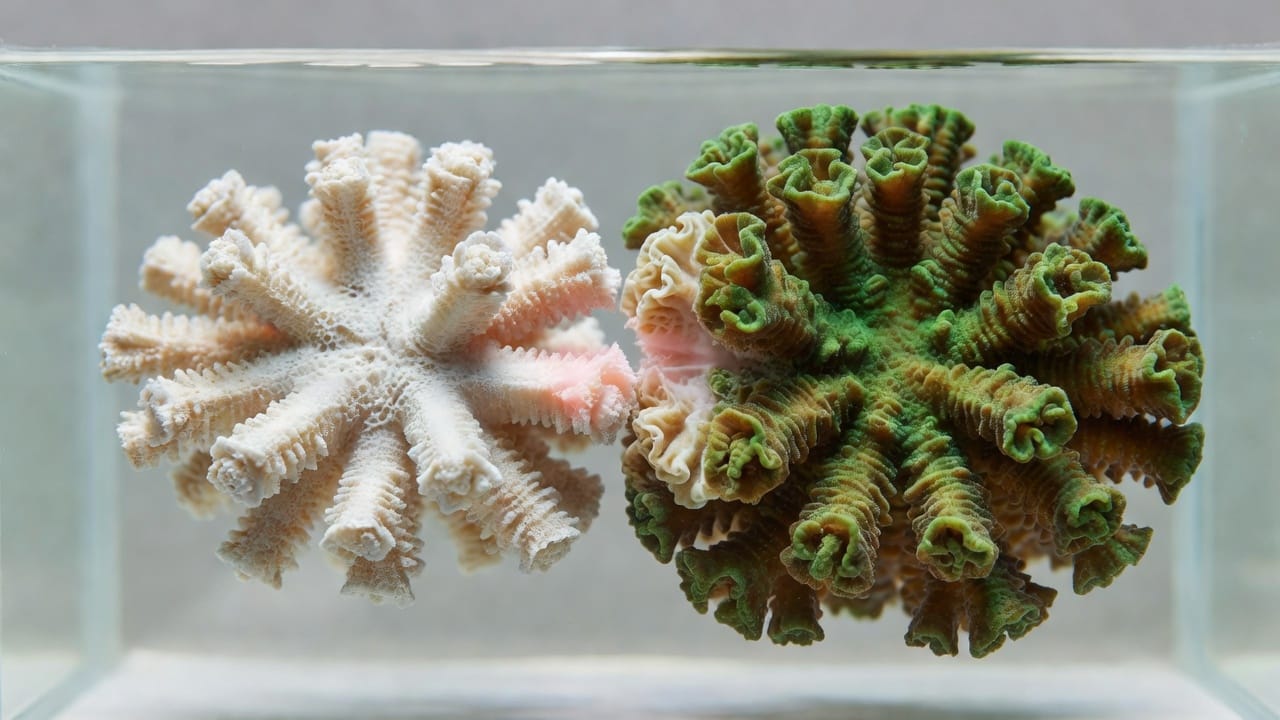
Danny Collins did not mean to start the experiment. He is a third-year PhD student in Stephen Palumbi's lab at Stanford. A healthy coral fragment ended up against a bleached one. The bleached piece started to colour up.
He then did it on purpose. Ten pairs, each pair a healthy fragment and a bleached fragment cut from the same animal. Five pairs placed so the tissue touched. Five pairs left a few millimetres apart. The five that touched recovered fully. The five with a gap died.
The paper in Science Advances, 14 October 2026, calls it the fastest documented recovery of bleached coral: seven weeks. In some cases three days of contact was enough to start the transfer. The algae that feed the coral moved across tissue that had fused.
Key Facts
- Science Advances, 14 October 2026: "Rapid coral bleaching recovery via symbiont transfer from healthy corals."
- Daniel S. Collins, Stephen R. Palumbi, Fiorenza Micheli, and colleagues, Stanford.
- Five touching pairs recovered fully. Five gapped pairs died.
- Seven weeks to full recovery. Three days of contact started the transfer in some cases.
- It works only between genetically identical members of the same colony.
Why This Matters
Restoration today is slow. Growing fragments and planting them takes months or years, often longer than a bleached colony has. A transfer that starts in days is a different kind of tool, if anyone can scale a clone bank. The paper is the first controlled demonstration of full recovery by this route.
Fiorenza Micheli, who co-directs Stanford's Center for Ocean Solutions, said the result opens a door. It does not walk through it. Michael Sweet, at the University of Derby, told the Financial Times that aquarists already knew algae can move between corals. What was new was a controlled paper. He also said the limit out loud.
What We Don't Know Yet
Nobody has done this on a reef. Nobody has shown it works between corals that are not clones. Nothing in the experiment stops the next marine heatwave. The IUCN says 44 percent of reef-building corals face a raised extinction risk. A tank does not change that figure.
Sources: SciTechDaily · Financial Times · Science Advances, 14 October 2026