China's Clean Energy Capacity Surpasses Fossil Fuels — A Global First
52% of China's operating power capacity now comes from non-fossil fuel sources — the first time clean energy has surpassed fossil fuels.
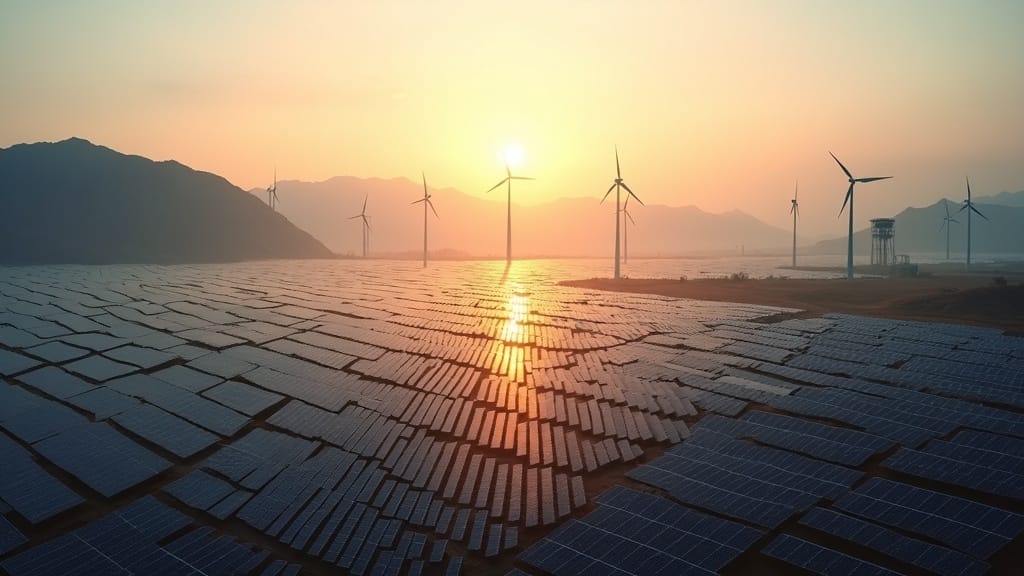
In a milestone that would have seemed unthinkable a decade ago, China — the world's largest energy consumer and carbon emitter — now generates more than half its power capacity from non-fossil fuel sources.
As of February 2026, 52% of China's operating electricity capacity comes from renewables, nuclear, and hydropower, compared to 48% from coal, gas, and oil. The crossover was driven by an extraordinary deployment of solar and wind: China installed over 430 million kilowatts of new capacity in 2025 alone, a 22% increase on the previous year.
The China Electricity Council projects that installed solar capacity will surpass coal within the next 12 months — a staggering trajectory for a country that just a few years ago was the world's biggest coal builder.
Key Facts
- 52% of China's power capacity is now non-fossil fuel (Global Energy Monitor, Feb 2026)
- 430 million kilowatts of new solar/wind installed in 2025, up 22% year-on-year
- Solar capacity projected to surpass coal within 12 months
- China accounts for approximately 30% of global CO₂ emissions
- China invested more in clean energy in 2025 than the rest of the world combined
Why This Matters
China's energy decisions are the single most consequential variable in the global climate equation. When the world's biggest emitter crosses the 50% clean energy threshold, it's not a symbolic gesture — it's a structural shift.
New investment is now overwhelmingly flowing into renewables because they're simply cheaper. Solar in China is now the cheapest electricity source in history, at less than 3 cents per kilowatt-hour. This economic logic makes the transition self-reinforcing: each year's new capacity is cleaner than the last.
The speed of China's deployment is rewriting energy forecasts globally. What the International Energy Agency projected would happen by 2030 has arrived four years early.
What We Don't Know Yet
Capacity and generation are different things. Solar panels produce power only when the sun shines; wind turbines only when wind blows. Coal still generates a disproportionate share of China's actual electricity because it runs around the clock.
China continues to approve and build new coal power plants, partly as backup capacity. Total energy consumption is still growing, meaning absolute CO₂ emissions may not have peaked yet despite the renewable surge.
Grid-scale storage and long-distance transmission — essential for matching intermittent supply with demand — remain works in progress.
Sources: IndexBox / Global Energy Monitor · OilPrice.com · Caliber.Az / NEA Data
Published February 18, 2026 · Category: Environment & Climate