China's Clean Energy Capacity Overtakes Fossil Fuels for the First Time
Non-fossil fuel sources now account for 52% of China's total power capacity — a structural milestone in the global energy transition.
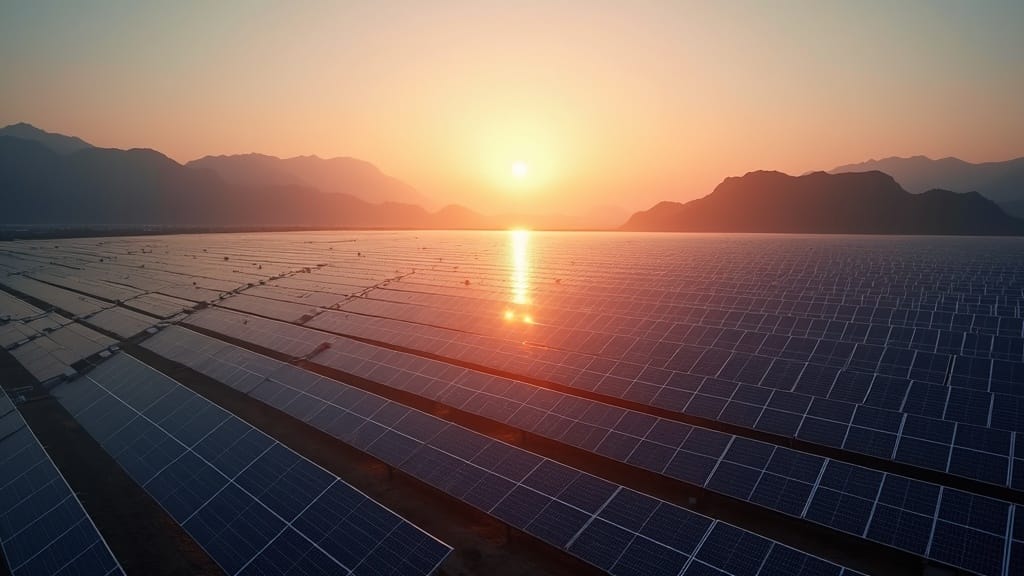
China has crossed a structural milestone in the global energy transition: for the first time in history, more than half of its total installed power generation capacity comes from non-fossil fuel sources.
As of February 2026, clean energy — solar, wind, hydro, and nuclear — accounts for 52% of China's operating power capacity, according to data tracked by the Global Energy Monitor. The country now has 73 GW more clean capacity than fossil fuel capacity in operation.
The speed of the shift has been extraordinary. China installed more solar capacity in 2023 alone than the United States has built in total. In 2024 and 2025, the pace accelerated further, driven by plummeting solar panel costs, aggressive provincial deployment targets, and a manufacturing ecosystem that now produces more than 80% of the world's solar panels.
To put this in perspective: China adds roughly the equivalent of the UK's entire electricity generating capacity every few months. The sheer scale of deployment has made China's clean energy buildout the single most important variable in global climate projections.
For the global climate effort, the milestone matters enormously. China is the world's largest energy consumer and its biggest carbon emitter, responsible for roughly 30% of global CO₂ emissions. While installed capacity does not equal generation — coal plants still run more hours per year than wind and solar, providing approximately 55% of actual electricity — the direction of travel is now unambiguous. The infrastructure is being built for a fundamentally different energy system.
The transition also carries geopolitical weight. China's dominance across clean energy supply chains — from polysilicon production to battery cell manufacturing — gives it significant leverage in the industries that will define the 21st-century economy. Countries seeking to build their own clean energy infrastructure increasingly depend on Chinese components, a dynamic that is reshaping trade relationships and industrial policy worldwide.
The milestone places China alongside Brazil, France, and Germany as major economies where clean sources dominate the power fleet. But China's scale makes the comparison almost misleading — its energy system is larger than any other country's, and the absolute volumes of clean capacity being added annually dwarf all others combined.
Key Facts
- 52% of China's operating power capacity is now non-fossil fuel
- China has 73 GW more clean capacity than fossil fuel capacity
- China installed more solar in 2023 than the US has built in total
- China produces more than 80% of the world's solar panels
- Coal still provides approximately 55% of actual electricity generation
Why This Matters
This milestone signals that the world's largest energy system has structurally pivoted toward clean power. While the transition is far from complete — and coal remains deeply embedded in China's energy mix — the investment trajectory is now self-reinforcing. Solar and wind are cheaper than new coal in most Chinese provinces, and the manufacturing ecosystem creates jobs and export revenue that generate their own political constituency for continued expansion.
Paired with India's record renewable additions announced this same week, the data suggests that the global energy transition is now being driven primarily by Asian deployment at scales that dwarf installations in Europe and North America.
What We Don't Know Yet
Installed capacity and electricity generation are different things. Coal's higher capacity factor means fossil fuels still dominate China's actual power output, providing roughly 55% of electricity. The capacity milestone is real, but the emissions milestone — when clean energy actually generates more electricity than fossil fuels — is still years away.
China continues to approve new coal plants, with approximately 100 GW of coal capacity in the development pipeline. The reasons are complex — energy security, provincial economic interests, grid reliability — but the contradiction between expanding renewables and expanding coal simultaneously remains unresolved.
Curtailment of wind and solar remains a significant issue in some provinces, meaning that not all clean capacity translates to clean electricity. Grid infrastructure and energy storage have not kept pace with the renewable buildout.
China's carbon emissions continue to rise, though the rate of increase is slowing. This is a milestone for capacity, not yet for emissions.
Sources: Reuters · IndexBox / Global Energy Monitor
Published 21 February 2026 · Category: Environment & Climate