A Bleached Coral Lived Because It Touched Its Clone
Stanford researchers report in Science Advances that bleached coral fragments fully recovered within eight weeks after brief contact with a healthy clone. Separated controls died.
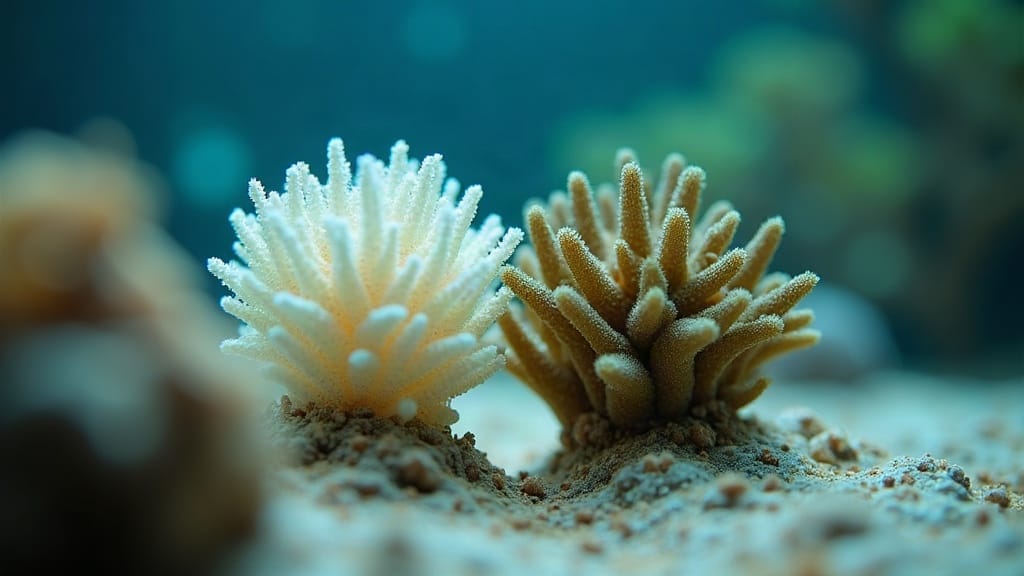
Five fragments recovered. Five a few millimetres away died.
In 2025, two pieces of coral in Steve Palumbi's lab at Hopkins Marine Station tipped over and landed on each other. One was bleached. One was not. They had come from the same colony. Where they touched, colour came back.
Danny Collins, an oceans PhD student at the Stanford Doerr School of Sustainability and a Knight-Hennessy scholar, turned that accident into a controlled trial. Science Advances published it on 14 October 2026, volume 12, issue 42. The species is Pocillopora damicornis. Collins set bleached fragments, about 1 to 1.5 centimetres, against healthy fragments of the same genet, meaning the same clone. Genetically identical corals recognise each other. Their tissue fuses. A transplant between identical twins is the comparison Palumbi used.
The paper's result is small and sharp. Every bleached fragment in direct contact, five of them, recovered completely within eight weeks. Fragments held a few millimetres apart died. Under the microscope, channels in the tissue lined up and algae plus the nutrients those algae make moved across. The team saw beneficial algae in the bleached piece within three days. A single week of contact was enough to start a recovery the bleached fragment could finish alone. In some pairs, three days was enough. Stanford's news office also described five-day separations that still completed. After the pieces were pulled apart, recovery still took about seven weeks, the same as pairs left touching the whole time. The algae that had already crossed were dividing inside the bleached coral, not commuting back for more.
In the second week of contact, those algae doubled about every four days. That is roughly ten times the rate measured in wild corals trying to reabsorb free-floating symbionts after a heat wave. Wild recovery, when it happens, is often measured in months or years. Fiorenza Micheli, Collins's advisor, said bleached corals get written off because of that pace.
The limit is in the method. It needs a healthy genetic copy of the colony you are trying to save. Collins and Micheli say that is not feasible at reef scale. Andrew Baker, a coral biologist at the University of Miami who was not on the paper, told Science the same thing: nobody is going to treat every colony on a reef by hand. The lab's next question is whether algae banked from healthy corals before a heat wave can be delivered without leaving the pieces touching. That experiment has not been reported.
Key Facts
- Science Advances, 14 October 2026, DOI 10.1126/sciadv.aeh1580
- Species: Pocillopora damicornis, same genet only
- Contact group: 5 of 5 fully recovered within 8 weeks
- Separated controls died
- Algae detected in the bleached fragment within 3 days
- One week of contact, sometimes 3 days, was enough to start self-recovery
- Algae in the recovering fragment doubled about every 4 days in week two
- Lead author: Danny Collins. Senior collaborator: Steve Palumbi
- Sources: Science Advances, Stanford Doerr School of Sustainability, Science magazine
Why This Matters
Bleaching is usually a eulogy. This is a transfusion with a control group, and the control group died. That is the kind of result a restoration field can use as a mechanism. It is not a technique you can already buy for a reef.
What We Don't Know Yet
Whether the fused tissue and the algal highway work in other species, in the ocean, or with corals that are not clones. The team has not shown a delivery method that skips the healthy twin. Eight weeks in a tank is not a heat wave on a reef that has no healthy neighbour left.