The Islands Without Rats
A study of 28 atolls found reefs building faster where rats are gone and seabirds still nest. The 5.9 millimetres a year is a model, and it does not replace emissions cuts.
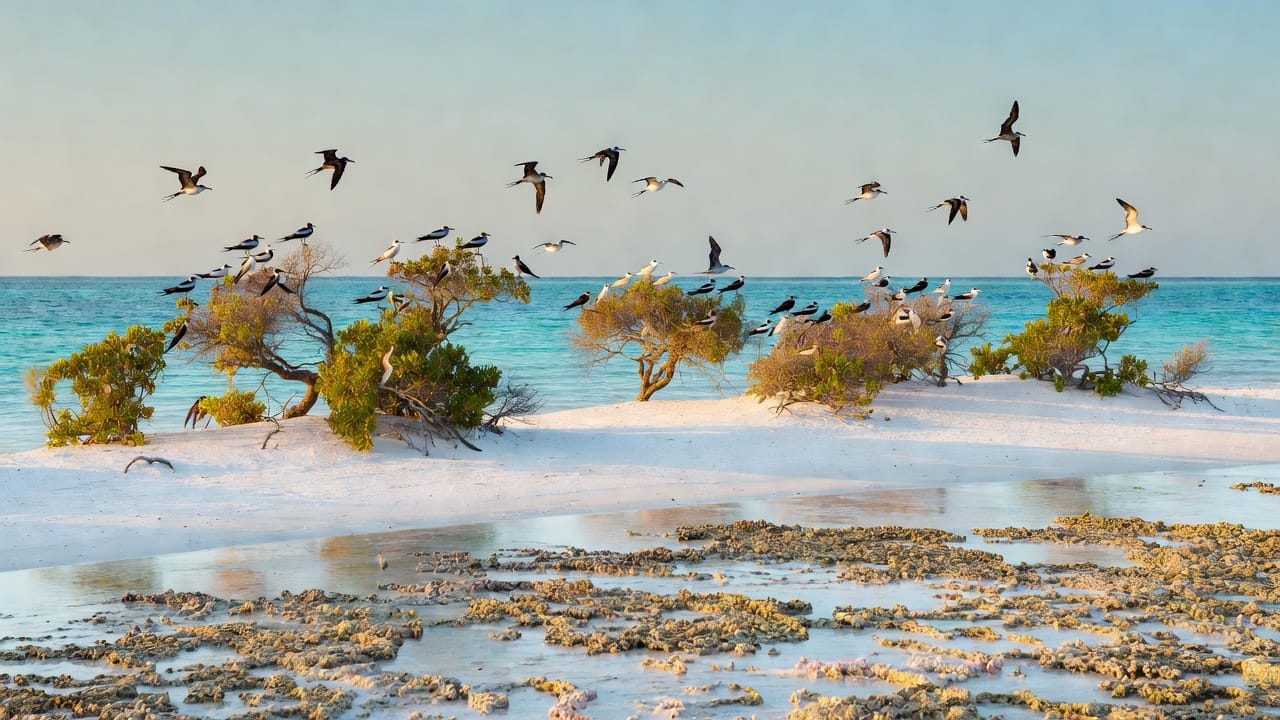
Where the seabirds still nest, the reef is building faster.
A low atoll is not a fixed object. The reef makes the sand. The plants hold it. Nicholas A. J. Graham of Lancaster University and colleagues looked at 28 of those islands, in the Seychelles, the Chagos Archipelago, and Teti'aroa, and asked what happens when the seabirds are still there.
On many atolls they are not. Rats, brought by ships, emptied the colonies. Seabirds feed at sea and drop the nutrients on the island and the reef around it. Without them, the engine idles.
The paper, in Science Advances on 14 October 2026, found reef accretion about 1.8 times higher on lagoonal reefs and about 2.5 times higher on ocean-facing reefs around rat-free islands than around rat-infested ones. Sediment production was 2.3 to 2.8 times higher where the rats were gone. Sites with high native vegetation had an estimated 4.6-fold greater fine-root length than sites with less of it. Coconut plantations do not hold the sand the way native forest does.
Lagoonal reefs beside rat-free, seabird-rich islands had an estimated median accretion potential of about 5.9 millimetres a year, nearly twice the figure beside rat-infested islands. Under the study's assumptions, that rate approaches local sea-level rise through 2100 in a 2°C warming scenario. Cassandra Benkwitt of The Nature Conservancy described a gain for the birds, the reef, and the island's chance of remaining above the water. Graham was plain that cutting greenhouse gases is still required.
The picture is a colony on a rat-free island, and the reef under it. The millimetres come second.
Key Facts
- 28 atoll islands: Seychelles, Chagos Archipelago, Teti'aroa
- Science Advances, 14 October 2026
- Reef accretion about 1.8× lagoonal and 2.5× ocean-facing on rat-free versus rat-infested islands
- Sediment production 2.3–2.8× higher around rat-free islands
- High native cover: estimated 4.6× fine-root length
- Lagoonal accretion potential about 5.9 mm/year beside seabird-rich islands
- Lead author: Nicholas A. J. Graham, Lancaster University
Why This Matters
The lever is local and already in use on other islands: remove the rats, let the birds back, stop replacing native forest with coconut. This paper's claim is that those steps change how fast the island's own geology keeps up, not only how many birds a warden can count.
What We Don't Know Yet
The 5.9 millimetres is an estimated potential, not a tide gauge on an island that grew that much last year. The comparison with sea-level rise holds under the study's assumptions, and under about 2°C, not under a hotter path. Faster reef growth does not replace emissions cuts. Rat eradication is hard, slow, and reversible if a ship brings them back.