Life's Building Blocks May Have Formed in Frozen Ice, Not Warm Water — Asteroid Bennu Reveals
Asteroid Bennu samples suggest life's building blocks formed in frozen ice, not warm water — vastly expanding where in the universe life could begin.
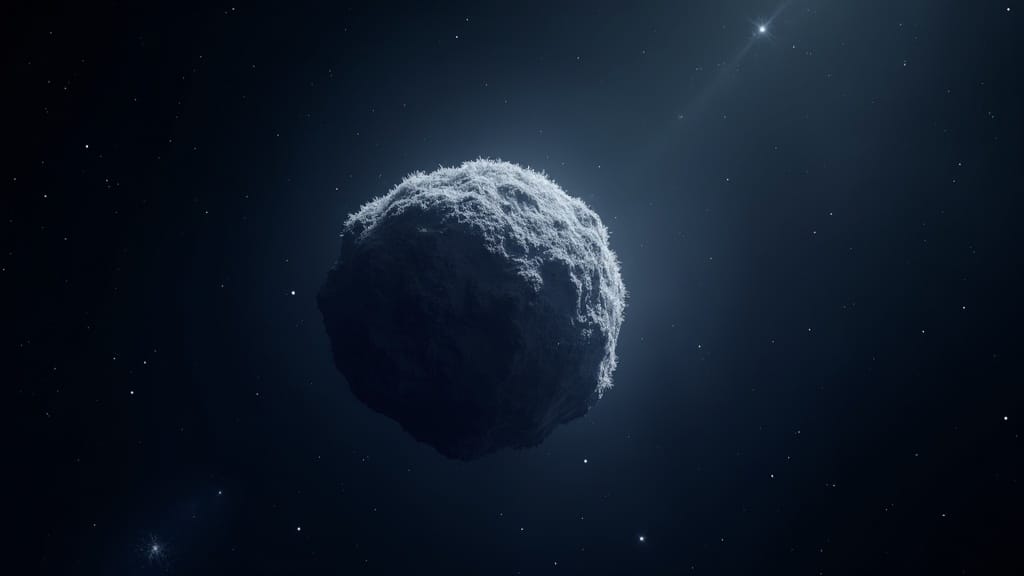
Analysis of dust returned from asteroid Bennu by NASA's OSIRIS-REx mission has upended a foundational assumption about how life begins: amino acids — the building blocks of proteins and life itself — may not require warm liquid water to form. Instead, the isotopic signature of glycine in Bennu's samples suggests these molecules formed in frozen ice exposed to cosmic radiation.
This is a paradigm shift. If life's essential chemistry can emerge in cold, irradiated ice — conditions found throughout the solar system and the wider universe — then the cosmic real estate where life's ingredients could form is vastly larger than anyone previously believed.
Icy moons like Europa and Enceladus. Comets. Interstellar dust clouds. Countless environments that were previously dismissed as too cold, too hostile, too dead for prebiotic chemistry suddenly become relevant to the question of how life begins.
The findings come from Penn State researchers working with the OSIRIS-REx sample cache. The mission collected approximately 121 grams of material from Bennu's surface in 2020 and delivered it to Earth in 2023 — the largest asteroid sample ever returned. These results represent some of the most consequential science yet to emerge from that precious cargo.
Key Facts
- Glycine isotopic signature in Bennu samples is inconsistent with warm-water formation (Penn State / ScienceDaily)
- OSIRIS-REx collected ~121 grams of asteroid material — the largest asteroid sample ever returned to Earth
- Previous models required liquid water at 20–100°C for amino acid synthesis
- New proposed pathway: UV and cosmic radiation acting on frozen ices containing simple molecules (ammonia, methane, CO₂)
- Bennu is a 4.5-billion-year-old carbonaceous asteroid — a pristine time capsule of early solar system chemistry
Why This Matters
The "warm little pond" hypothesis — that life's chemistry started in liquid water — has dominated origin-of-life research since Darwin. Meteorite studies have found amino acids before, but they were assumed to have formed through aqueous alteration, meaning water-rock interactions at moderate temperatures.
Bennu's samples are different. Collected directly from the asteroid surface rather than surviving the violence of atmospheric entry, they provide a far cleaner window into pre-biological chemistry. The isotopic evidence points firmly toward cold formation.
If amino acids form readily in ice under radiation — conditions that exist across vast stretches of the cosmos — then the raw ingredients of life could be far more widespread in the universe than the traditional "Goldilocks zone" model suggests. It doesn't mean life is common, but it means the starting materials are.
What We Don't Know Yet
Amino acid presence does not equal life. The gap from amino acids to self-replicating biology is enormous and poorly understood. This finding expands where ingredients form, not where life arises.
This is a single asteroid sample. Whether the ice-radiation pathway is a universal phenomenon or specific to Bennu's history is uncertain.
The cold formation pathway is proposed, not definitively proven. Alternative explanations may emerge as more of the sample cache is analysed — and it will be studied for decades.
The finding has inherently limited practical applications. This is fundamental science that reshapes our understanding of the cosmos, not a technology that can be deployed or scaled.
The results are preliminary. The Bennu samples are a finite, irreplaceable resource, and the scientific community will rightly move carefully in drawing conclusions.
Sources: Penn State University · NASA OSIRIS-REx · ScienceDaily
Published 16 February 2026 · Category: Science & Technology