Faster, Then a Stop
A Science paper on more than 15,000 Antarctic ice cliffs finds collapses were faster than models, and that the runaway did not follow. No sea-level centimetre is in the result.
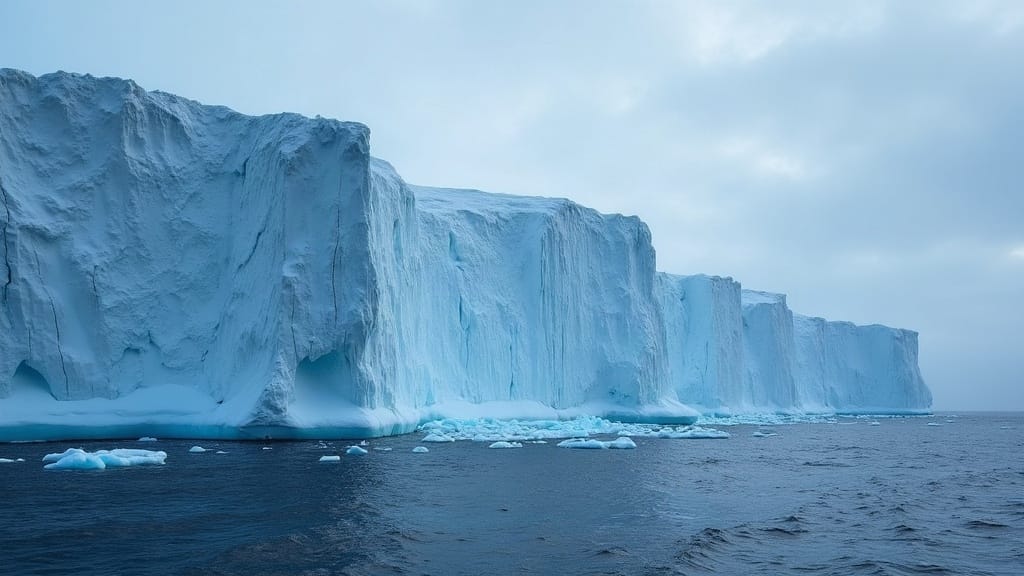
Caroline Needell has spent four years of satellite passes on a fear that has a name. Marine ice cliff instability says a cliff of ice taller than about 100 metres should fall under its own weight, expose a taller cliff inland, and keep going. The cliffs she measured fell faster than that story's models. Then they stopped.
MIT News, on 15 October 2026, reported the paper in Science. Needell, a graduate student in the MIT–Woods Hole Joint Program, with Catherine Walker at Woods Hole and Jeremy Bassis at the University of Michigan, used NASA's ICESat-2. From 2019 to 2023 the satellite measured more than 15,000 Antarctic ice cliffs, about every three months. The average cliff in that set was about 30 metres. A few were over 100. When cliffs retreated, they retreated faster than the models had assumed. That part is worse news for sea level, for as long as the retreat lasts. The retreat did not last. The glaciers they watched spread back toward the ocean and stabilised. Needell said they do not see the runaway effect.
Bassis told Michigan Engineering the same day that high-end sea-level estimates should not be waved away, and that a total disintegration of the ice sheet is not what these examples support. Both halves of that sentence have to travel together. A companion summary the same day, covering Greenland as well as Antarctica, said only 5 percent of observed Antarctic cliffs exceed 52.2 metres, and only 5 percent of Greenland cliffs exceed 76.6 metres. Applied to Thwaites, that summary says an ice-shelf failure at the current grounding line would be unlikely to start an immediate cliff-driven retreat. That is an argument about one glacier's present geometry. It is not a forecast that West Antarctica is safe.
Needell's own next-step sentence is the one to keep. Bed topography, and how fast the ice is thinning, are what a projection needs. Height alone was the old shortcut. The paper does not print a sea-level centimetre.
Key Facts
- Science, 15 October 2026. Caroline Needell, Catherine Walker and Jeremy Bassis. DOI 10.1126/science.aee0658.
- More than 15,000 Antarctic ice cliffs, ICESat-2, 2019 to 2023. Average height about 30 metres.
- Collapses were faster than models. The retreat was short-lived. The watched glaciers stabilised.
- No sea-level contribution in centimetres is a result of this paper.
Why This Matters
The scary version of Antarctic collapse has been a height. This paper says height is not enough, and it says the collapses that do happen can be faster than the cautious models. That is a narrower fear, not a cancelled one.
What We Don't Know Yet
A sea-level number. Whether a future Thwaites, with a different bed and a faster thinning rate, still stops. How the Greenland record and the Antarctic record should be spoken in one sentence.