AI Prosthetic Arms Feel Most Natural at One Second Per Reach, VR Study Finds
A VR study found AI prosthetic arms feel most natural at human speed — one second per reach. Faster feels creepy, slower feels frustrating.
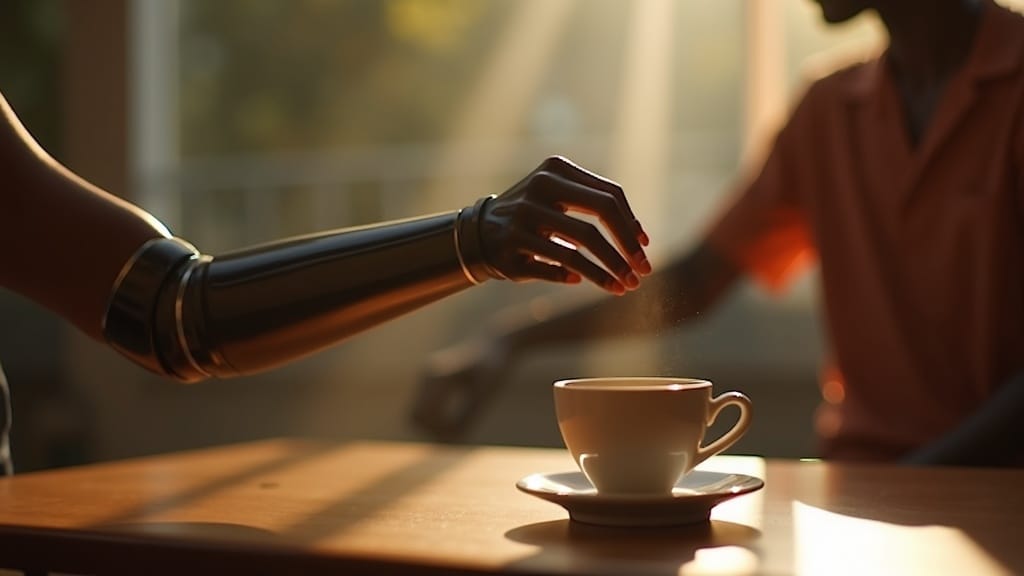
Japanese researchers have used virtual reality to solve one of the most overlooked challenges in prosthetic design: how fast should an AI-powered arm move to feel like it belongs to you?
The answer is approximately one second per reaching motion — matching the natural speed of a human arm.
Using VR simulations that let participants experience AI prosthetic arms at different speeds, the team found a clear psychological sweet spot. When the arm moved faster than natural human speed, users reported discomfort and a sense of uncanniness — the robotic equivalent of the "uncanny valley" effect known from humanoid faces. Too slow, and the arm felt unhelpful and disconnected.
At natural human speed, users reported the highest sense of body ownership and comfort. The arm felt like theirs.
This matters because the next generation of prosthetic arms will increasingly be AI-driven, capable of anticipating and executing movements autonomously. Engineering capability has outpaced psychological research. We can build arms that move faster than human limbs — but now we know we shouldn't.
The finding provides the first concrete speed parameter for designers of AI-driven autonomous prosthetic movement, filling a critical gap in guidelines that could improve adoption rates.
Key Facts
- Optimal perceived speed: approximately 1 second per reaching motion (ScienceDaily / TechXplore)
- VR simulation used to test multiple speed conditions without building physical prototypes
- Faster-than-human movement triggered "uncanny valley" discomfort responses
- Approximately 2 million people in the US live with limb loss (Amputee Coalition)
- The AI prosthetics market is projected to grow significantly through 2030
Why This Matters
Prosthetic technology has advanced dramatically in the past decade. Myoelectric and brain-computer interface systems enable increasingly natural control. But adoption rates remain stubbornly lower than expected — many amputees abandon their prosthetics within the first year.
Research consistently shows that comfort, perceived naturalness, and sense of embodiment matter as much as raw functionality. A prosthetic arm that can move at superhuman speed but feels alien is worse than a slower arm that feels like part of you.
This study bridges engineering and psychology. It gives designers a concrete, evidence-based target: match human speed. Don't exceed it. It's a simple rule that could make the difference between a prosthetic that stays in a drawer and one that becomes part of someone's daily life.
What We Don't Know Yet
This was a VR simulation, not a study with real prosthetic devices. Embodiment and perception may differ when someone is actually wearing a physical prosthetic arm versus experiencing one in virtual reality.
The study likely used able-bodied participants in VR. The experience of people who have actually lost a limb — and who have a different relationship with body image and ownership — may differ significantly.
"One second per reach" is a simplified metric. Real-world tasks vary enormously in complexity, distance, and context. Whether this single parameter holds across all movements is unknown.
Cultural factors in the perception of robotic movement weren't explored. Attitudes toward robots and artificial limbs vary across societies, which could affect comfort thresholds.
It's a single study. Replication across diverse populations, tasks, and actual prosthetic hardware is needed before it becomes a design standard.
Sources: ScienceDaily · TechXplore · Amputee Coalition
Published 16 February 2026 · Category: Health & Medicine / Science & Technology